Voice Journaling vs Typed Journaling: What Science Says About Retention
Voice journaling vs typed journaling benefits compared. See what research says about memory retention, emotional processing, and productivity for knowledge workers.
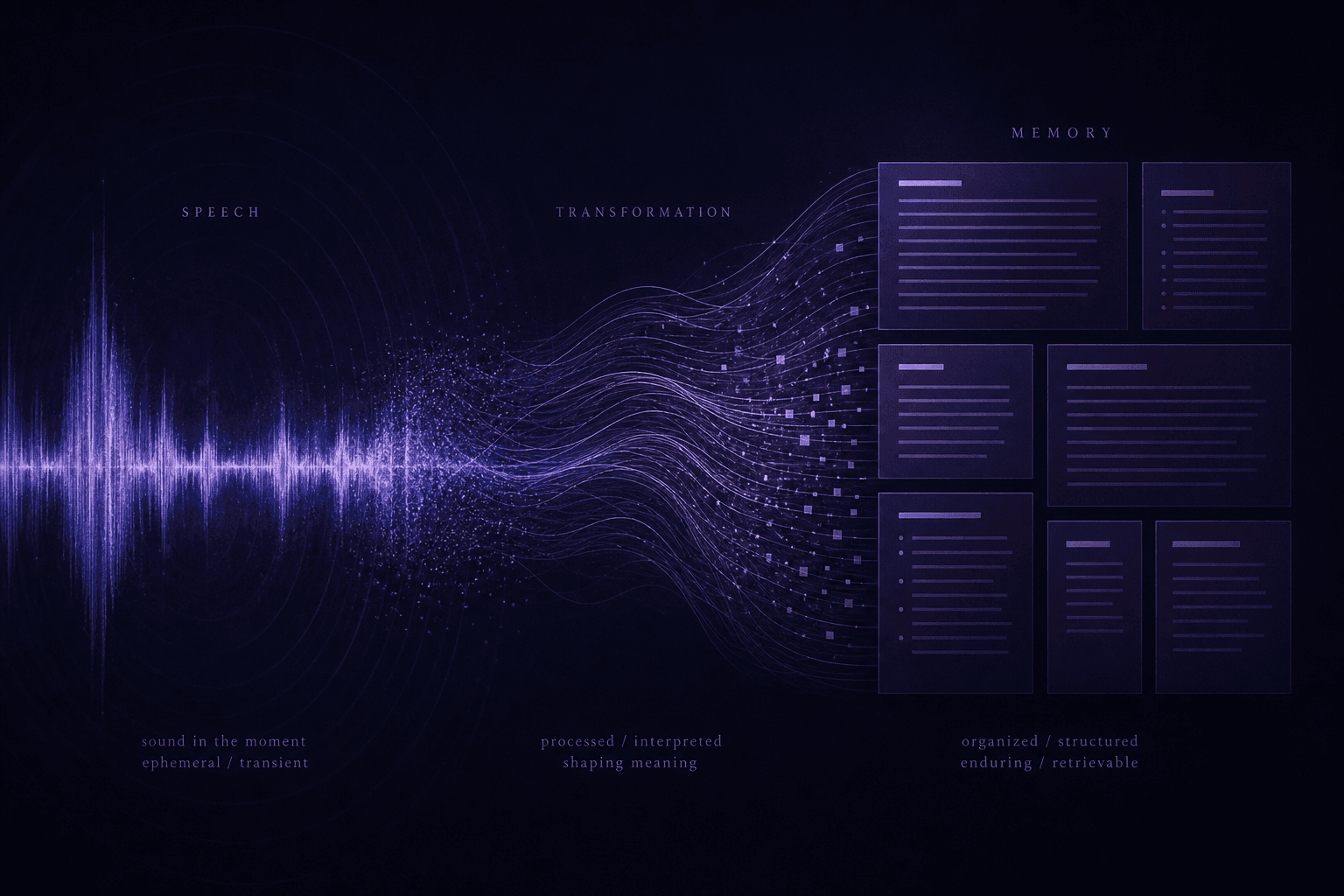
You think faster than you type. That gap — between the thought and the keystroke — costs you ideas, nuance, and emotional accuracy. For knowledge workers drowning in Slack threads and Google Docs, the format of your journal matters more than you think.
Here's what the research actually says about voice journaling vs typed journaling benefits, specifically around retention, emotional processing, and follow-through.
The Speed Gap: Why It Matters for Retention
Most people speak at 130–150 words per minute. Average typing speed sits around 40 wpm. That's a 3x difference in throughput.
This isn't just about efficiency. When you type, your working memory is split between forming thoughts and translating them into keystrokes. Research from the Frontiers in Psychology journal has shown that cognitive load during recording affects both the depth and accuracy of what gets captured.
Speaking eliminates that translation layer. You say what you think, in the order you think it. The result is a more complete, less filtered record of your actual mental state.
Emotional Processing: Voice Carries What Text Drops
Typed entries flatten emotion. You edit as you go. You rephrase. You soften.
Voice captures tone, hesitation, emphasis, and pace — what psychologists call prosodic cues. These cues are central to emotional processing. James Pennebaker's decades of research on expressive disclosure at the University of Texas at Austin found that the act of putting experiences into words — especially spoken words — reduces the cognitive burden of unresolved thoughts. His work, widely cited in the field, is a foundation for understanding why talking through problems works. You can explore his research through the UT Austin Psychology Department.
For knowledge workers, this matters. That lingering frustration from a meeting, the half-formed idea you can't articulate in a Notion doc — speaking it captures the full signal, not just the words.
Memory and Recall: The Act of Speaking Encodes Differently
There's a well-documented phenomenon called the production effect: information you say aloud is remembered better than information you read silently or type. A study published in the journal Memory by researchers at the University of Waterloo found that speaking words aloud created a distinct memory trace, improving later recall compared to silent reading or typing. The research is summarized on the University of Waterloo news page.
When you do a 60-second voice brain dump about your day, you're not just logging information. You're encoding it more deeply. That's why people who use voice journaling often report remembering things from their entries without re-reading them.
The Practical Tradeoff: Searchability vs. Completeness
Typed journals have one clear advantage: they're instantly searchable. You can Cmd+F a keyword and find it.
But that advantage disappears when AI handles the transcription. If your voice entry is automatically transcribed, tagged, and organized, you get the recall benefits of speaking plus the searchability of text.
This is exactly what Acuity does. You talk for 60 seconds — a brain dump whenever it fits your day — and AI extracts tasks, tracks goals, detects mood patterns, and surfaces themes over time through the Life Matrix. No typing. No formatting. No friction.
What About Handwriting?
Fair question. Research from Psychology Today and various studies suggest handwriting also produces strong encoding effects, particularly for learning. But handwriting is slow (13 wpm average) and creates records that are hard to search, analyze, or act on.
For knowledge workers who need both reflection and actionable output, voice hits the sweet spot between depth and utility.
The Bottom Line for Knowledge Workers
If you journal to think clearly, process emotions, and actually remember what happened in your week — voice is the stronger format. The science on retention, emotional processing, and cognitive load all point the same direction.
Typed journaling isn't bad. It's just slower, shallower, and higher friction for most people. That friction is why most knowledge workers quit journaling within two weeks.
Speaking is what your brain already does. A journal should work with that, not against it.
FAQ
Is voice journaling better than typed journaling for memory?
Research on the production effect suggests yes. Speaking information aloud creates a stronger memory trace than typing it silently. Combined with AI transcription, you keep the recall benefit without losing searchability.
Does voice journaling help with emotional processing?
Spoken entries preserve emotional tone — hesitation, emphasis, frustration — that typed entries tend to flatten. Decades of research on expressive disclosure support that verbalizing experiences reduces their cognitive burden.
How long does a voice journal entry need to be?
Sixty seconds is enough. At 150 words per minute, that's a 150-word entry — more than most people type in a 5-minute journaling session. Brevity plus consistency beats occasional long entries.
Can I search voice journal entries like typed ones?
If your app transcribes audio automatically, yes. Acuity transcribes every brain dump and uses AI to extract tasks, mood patterns, and themes — giving you full searchability plus voice's retention advantages.
Try Acuity free for 14 days — no card required.
Related reading:
Brain dump daily. Get your life back.
Try Ripple free for 7 days. Just talk. No typing. Just talk.
No credit card required · Cancel anytime